That is the forthright slogan of the Egg Cuber, which unfortunately is not available anymore or I would certainly go out and buy one.
A detailed look at the IDPC and drug reform policy from the UK. From Charles Shaw of "Exile Nation" on openDemocracy.net.
The International Drug Policy Consortium (IDPC), a global network of NGOs and professional networks that specialize in issues related to the production and use of controlled drugs, recently published the first edition of their Drug Policy Guide aimed at national policymakers. This visionary group was initiated by the vanguard Beckely Foundation and is being managed by Release, a UK legal advisory group for drugs and human rights that provides free & confidential counsel to public and professional policymakers. IDPC received funding and assistance from the European Commission's Drug Prevention & Information Programme.
The Drug Policy Guide "brings together global evidence and best practices on the design and implementation of drug policies and programs at national level" by showcasing "a growing number of policy and program options available to address the harms that are associated with drug markets and drug use."
The IDPC operates from five fundamental principles:
- Drug Policy Decisions Should be More Informed by the Best Available Evidence
- Drug Policies Should Shift Focus and Priority from Reducing the Scale of the Drug Market to Reducing its Negative Consequences
- Efforts to Reduce the Supply of Drugs Should Not Focus on the Punishment of Growers
- Efforts to Reduce the Demand for Drugs Should Not Focus on The Punishment Of Users
- The UN System Should Develop a More Co-ordinated and Cohesive approach to Drug Policy Issues
 |
Alternet on the golden era of psychedelic research [by John Perry Barlow, Grateful Dead lyricist, founder of the EFF, etc.]. A very long article.
It’s now almost half a century since that day in September 1961 when a mysterious fellow named Michael Hollingshead made an appointment to meet Professor Timothy Leary over lunch at the Harvard Faculty Club. When they met in the foyer, Hollingshead was carrying with him a quart jar of sugar paste into which he had infused a gram of Sandoz LSD. He had smeared this goo all over his own increasingly abstract consciousness and it still contained, by his own reckoning, 4,975 strong (200 mcg) doses of LSD. The mouth of that jar became perhaps the most significant of the fumaroles from which the '60s blew forth.
Everybody who continues to obsess on the hilariously terrifying cultural epoch known as the '60s -- which is to say, most everybody from "my gege-generation," the post-War demographic bulge that achieved permanent adolescence during that era -- has his or her own sense of when the '60s really began. There are a lot of candidates: the blossoming pink cloud in the Zapruder film, Mario Savio’s first speech in Sproul Plaza, the passage of the Gulf of Tonkin Resolution, the Beatles’ first appearance on the the Ed Sullivan Show, the first Acid Test, the Human Be-In in Golden Gate Park, the release of the song "Good Vibrations," the day Jerry Garcia got kicked out of the army. But as often as not, if you are a Boomer, the '60s began for surreal on the day you dropped acid. And if that is when the shit hit your personal fan, you may owe a debt of ambiguous gratitude to the appealingly demonic young sociopath who conveyed the Stark Bolt of Chemical Revelation to the nice young gentlemen of the Harvard Psilocybin Project.
[Thanks Soma Junkie!]
The latest Ignite podcast is an entertaining talk on the chemistry of wine, covering how it's made, why it tastes the way it does, and how synesthesia and expectation affect how it tastes:
The gorgeous animation in this video really requires full screen, and I'd recommend headphones for the luscious audio:
from the album Do Outro Lado Do Espelho (Lylac Ambient Reworks)
 | | Poutine of foie gras |
The NYTimes just ran a surprisingly nifty piece about the role of marijuana in professional kitchens:
In the 1980s, cocaine helped fuel the frenetic open kitchens and boisterous dining rooms that were the incubators of celebrity chef culture. Today, a small but influential band of cooks says both their chin-dripping, carbohydrate-heavy food and the accessible, feel-good mood in their dining rooms are influenced by the kind of herb that can get people arrested.
Call it haute stoner cuisine.
“There has been an entire strata of restaurants created by chefs to feed other chefs,” Mr. Bourdain said. “These are restaurants created specially for the tastes of the slightly stoned, slightly drunk chef after work.”
As examples of places serving that kind of food, he offered some of David Chang’s restaurants; Au Pied de Cochon in Montreal, with its poutine of foie gras; Crif Dogs in the East Village, which makes a deep-fried cheese steak hot dog; and, in fact, the entire genre of mutant-hot-dog stands.
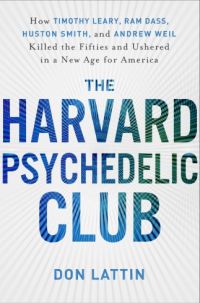 |
Originally published in 2010 ‘The Harvard Psychedelic Club’ by Don Lattin is a work of narrative non-fiction. It biographically examines the lives of four men, involved in various ways with what was originally called the Harvard Psilocybin Project. Based on interviews with the surviving members and written accounts, Lattin’s book is a highly readable text of the impact these men had on both one another and wider society.
The four men in question are Timothy Leary, Richard Alpert (now Ram Dass,) Andrew Weil and Huston Smith; who are respectively given the monikers the Trickster, the Seeker, the Healer and the Teacher. The structure of the book, a narrative non-fiction, follows the lives of these four people; from their younger days, to when their paths intersected with one another at Harvard University during the late 50s and early 60s, to the subsequent impact their lives and careers have had on society.
In understanding the picture that Lattin paints of these people it is important to bear in mind the monikers he has labelled them with; for not only do they give indication of the circumstances of their lives but they irrevocably determine their characterization in the text...
From Musings of the Mad Artist:
It’s been a long time since I read a book that has held so much personal significance for me as Andy Roberts’ Albion Dreaming, which with great enthusiasm and obvious love for the subject matter, relates the specifics of how LSD tripped out British culture—a story as least as interesting as its American counterpart, featured in works such as Storming Heaven and Acid Dreams. Many intriguing threads are woven together, from early military experiments in the ’50s at the infamous Porton Down chemical weapons facility, where unwitting volunteer servicemen ‘were expected to hallucinate for Queen and country’; to early examples of LSD psychotherapy, involving famous figures such as the comedian Frankie Howerd and actor Sean Connery; to the more familiar ‘swinging ’60s’, the free festival movement and beyond.
Great article from AlterNet:
According to a new study released this week, caffeine turns human beings into efficient worker bees. Led by Katharine Ker of the London School of Hygiene and Tropical Medicine, the study found that caffeine "significantly reduced the number of errors" made by workers in a series of 13 trials. "One trial comparing the effects of caffeine with a nap found that there were significantly less errors made in the caffeine group," reads the official report.
What? Coffee beats naps?
"The results of the trials suggest that compared to no intervention, caffeine can reduce the number of errors and improve cognitive performance in shift workers. ... Based on the current evidence, the review authors judge that there is no reason for healthy shift workers who already use caffeine within recommended levels to improve their alertness to stop doing so."
This study is very convenient, since there's a $60 billion-plus industry pushing hard to promote caffeine's image. Slurp.
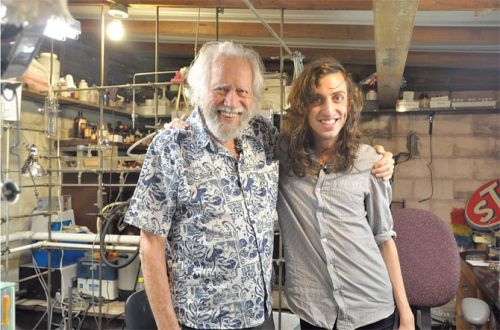
Vice Magazine's Hamilton Morris went on a pilgrimage to interview Sasha Shulgin and filed a long report, which is not really an interview. Here is a small chunk of random conversation:
When I arrived at Shulgin's home in Lafayette, California, he was peacefully sitting at the kitchen table. I walked through the sliding glass door, greeted him, and then embraced him, which produced a euphoria far greater than that of MDMA and a time dilation more profound than the effects of 2C-T-4. We disengaged and, without pause, he began to riddle me: "Can you name the two words in the English language that begin with two consecutive a's?"
I thought for a moment before answering, "Aardvark is one?"
"Yes, good, and the other?"
"I don't know, I can't think of another."
He bent down his head and said in a low whisper, "Aardwolf."
"Aardwolf?" I asked, and with that he had already risen from his chair and shuffled into the hallway to retrieve a giant yellow dictionary, which he dropped onto the kitchen table and pushed toward me. Sure enough, it's there, and on his prompt I read the definition aloud:
aard-wolf \-'wu-lf\ n, pl aard-wolves \--lvz\ [Affric, fr. aard earth + wolf; akin to OE wolf wolf--more at WOLF] 1: a hyenalike quadruped of South Africa having a striped coat, five-toed forefeet, and a distinct mane, feeds chiefly on carrion and insects (as termites), and is usu. placed in the Hyaenidae though formerly separated in another family (Protelidae). 2: an (extremely) unexpected nonpsychedelic-related thing, which confuses me [see more at I'M NOT PREPARED FOR THIS].
"OK," Shulgin said, satisfied. "We've solved that problem. But now, for example, do you know what a lowena is?"
"No, what's that?" I asked credulously.
"It's the opposite of a highena."
"Aha!" I urinated a microliter in my pants and changed the subject. "I brought you a peach pie. Would you like a slice?"
He answered the question with another question: "How many numbers are to the right of the decimal point in pi?"
"Just one." I had nervously confused right and left, but Shulgin immediately adjusted his line of questioning.
"OK, so what is the value of pi? 3.14159265" But how many numbers can appear in front of the decimal point in pi or in any rational number?"
"Potentially an infinite amount of numbers."
"Right, and how large is this infinity?"
"Excuse me?"
"How large is this infinity?"
"That's a difficult question to answer," I replied.
"I'll give you another question and let you do a comparison: How many numbers are there to the right of the decimal point? One? An infinite number? Not only an infinite number but an infinitely larger infinite number."
"How can? OK, wait..."
[Thanks mj!]
|

Recently @ DoseNation
|
|