 |
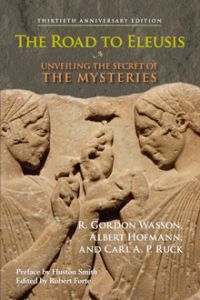
Originally published in 1978 'The Road to Eleusis: Unveiling the Secret of the Mysteries,' by R. Gordon Wasson, Albert Hofmann and Carl A. P. Ruck, was only reprinted as a paperback in English for the first time in 2008, for its thirtieth anniversary edition. The work of an amateur mycologist, a chemist and a classicist, the text attempts to solve the mystery of the Eleusinian rites of ancient Greece by hypothesizing the use of an ergot-derived hallucinogen.
The first three chapters were initially read as papers, by the three respective authors, before the Second International Conference on Hallucinogenic Mushrooms, in Washington, on Friday, 28th October 1977. Essentially, there are two important objectives that are running in tandem with one another in this text. Firstly the hypothesis itself that draws on the relevant expertise of its authors; the multidisciplinary approach is highly effective. Secondly, it is a treatise on the entheogenic discourse; indeed, the term was originally coined/announced by the authors at the conference...
CNN's Campbell Brown talks to Dr. Sanjay Gupta and Dr. Stephen Ross about psychedelic drugs for medicinal purposes.
[Thanks Romik!]
 |
A new paper from 'Drug Alcohol Dependence' reviews the effects of Salvia from video reports on YouTube.
Salvia divinorum (salvia) is an intense, short-acting hallucinogenic plant gaining popularity among adolescents in the United States. There has been little scientific documentation of salvia's effects. The popular video-sharing website YouTube has received literally thousands of video-posts of people using salvia. The objective of this study was to assess the effects of salvia use through systematic observations of YouTube videos. A sample of salvia videos was obtained using the search term "salvia." The videos were further screened and only videos that captured the entire drug "trip" without video edits were included in the analyses described here (n=34). Three trained research assistants independently watched the videos and rated their observations on 42 effects in 30-s intervals. Onset of symptoms was quick (often less than 30s) and tended to dissipate within 8min. Further, there was a relationship between salvia dose and effect duration. Since salvia's effects on humans are largely undocumented, this study provides the look at users in a non-laboratory environment (e.g. self-taped videos) exhibiting impairments and behaviors consistent with this powerful hallucinogen. Also, this study demonstrates the feasibility and shortcomings of using YouTube videos to assess emerging drugs and drug effects.
By way of Thomas and BoingBoing.net.
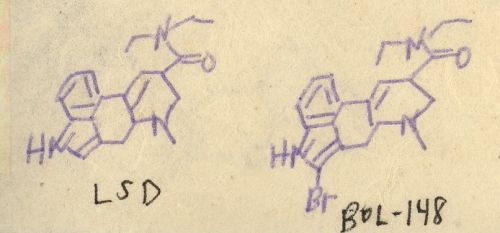
From the LSD Research blog:
BOL-148 is the 2-brom derivative of LSD. There is a bromine in place of hydrogen at position 2.
In spite of its close structural relationship to LSD, BOL-148 has no psychedelic effects. In 15 healthy males, doses of 75-110 ug/kg BOL-148, which 100X exceed an effective dose of LSD, caused no change in pupillary dilation, patellar reflex, or blood pressure (H. Isbell, 1959). BOL-148 did not alter the behavior of 6 individuals with schizophrenia, when given at 10X the dosage of active LSD, although for BOL-148 these doses may have been too low to observe any effect. One mg BOL-148 twice a day for 2 weeks, or 5 mg for 3 days had no evident effect on their psychoses (W.J. Turner, 1958).
Unlike LSD, which is one of the most potent drugs known to affect the electrical potentials of the brain, BOL-148 is without effect on the EEG. There was no sign of the fast electrical activity or alerting behaviour seen with injections of LSD in cats, even when doses of up to 100 ug/kg of BOL-148 were used intraventricular (P.B. Bradley, 1956). BOL-148 produced no EEG changes in Macaca mulatta, in high dose ranges 110-175 ug/kg (R.R. Monroe, 1961). Saline gave the same response as 1000 ug/kg BOL-148 in cats with permanently implanted EEG electrodes (E. Eidelberg, 1965). In rabbits, 500 ug/kg BOL-148 failed to produce EEG alerting for longer than 15 minutes (A.K. Schweigerdt, 1966).
BOL-148 has a very slight change in molecular structure compared to LSD, but it has none of the behavioral effects of LSD. When LSD or BOL-148 were administered intraventricularly to cats, LSD caused behavioral arousal whereas BOL-148 produced mild sedation (P.B. Bradley, 1956). In rabbits, BOL-148 had a neutral effect on eyeblink conditioning, whereas LSD enhances this specific type of behavioral learning (J.A. Harvey, 2003). No affective changes in Papio papio were observed after BOL-148 in doses of 2-4 mg/kg (M.D. Fairchild, 1980).
MAPS conference caught in the echo chamber:
The big white pill was brought to her in a chalice. She'd already held hands with her two therapists and expressed her wishes for what it would help her do.
She swallowed it, lay on the couch with her eyes covered, and waited. And then it came.
"The world was made up of jewels and I was in a dome," she recalled. Surrounded by brilliant, kaleidoscopic colors, she saw the dome open up to admit "this most incredible luminescence that made everything even more beautiful."
Tears trickled down her face as she saw "how beautiful the world could actually be."
That's how Nicky Edlich, 67, began her first-ever trip on a psychedelic drug last year.
She says it has greatly helped her psychotherapeutic treatment for anxiety from her advanced ovarian cancer.
And for researchers, it was another small step toward showing that hallucinogens can one day help doctors treat conditions like cancer anxiety and post-traumatic stress disorder.
The New York University study Edlich participated in is among a handful now going on in the United States and elsewhere with drugs like LSD, Ecstasy and psilocybin, the main ingredient of "magic mushrooms."
"There is now more psychedelic research taking place in the world than at any time in the last 40 years," said Rick Doblin, executive director of the Multidisciplinary Association for Psychedelic Studies, which funds some of the work.
He said more than 1,200 people attended a conference in California last weekend on psychedelic science. But doing the research is not easy, Doblin and others say.
Government funders are still leery, and drug companies aren't interested in the compounds they can't patent. That pretty much leaves private donors.
"There's still a lot of resistance to it," said David Nichols, a Purdue University professor of medicinal chemistry.
"When you tell people you're treating people with psychedelics, the first thing that comes to mind is Day-Glo art and tie-dyed shirts."
 |
A significant majority of Americans support legalizing marijuana and regulating it either with the same rules that apply to alcohol or with fewer restrictions, according to a new poll. The survey was released on April 20 and made headlines because 55 percent of respondents said they oppose legalizing marijuana.
But digging deeper into the poll finds that, when pot is compared to alcohol, support for reforming the laws surges. Forty-four percent of respondents said that "the regulations on marijuana [should] be the same as those for alcohol." Another 12 percent said they should be "less strict," meaning that a full 56 percent support the policy change -- perhaps the highest number ever recorded in favor of legalization. (Alcohol is, after all, legal.)
The poll of 1,001 Americans GfK Roper for CNBC's "Marijuana & Money" report. The margin of error was 4.3 points.
By a 2 to 1 margin, people said that if marijuana were legalized, they would favor allowing the government to tax sales of marijuana.
The survey comes as California voters consider whether to legalize marijuana in the fall elections and groups in Washington state and Oregon are pushing to get similar legislation on the ballot in their states. A CBS News poll, also released on April 20, found that 55 percent of voters in the west support legalizing pot.
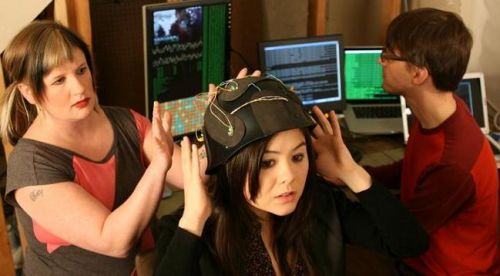 Photo by Ian Johnston
I've written a new science fiction play which is premiering this Friday at Annex Theatre in Seattle. If you'll be in Seattle over the next month, stop by and check out the show!
When I Come To My Senses, I'm Alive! tells the story of a technological provocateur, Annique, who invents a method for capturing emotions as digital information, as part of a project to "chart the emotional genome." She develops a cult following of fans who download her very addictive "emoticlips" - each delivered with cryptic, poetic file names like "the surprise of an unfamiliar memory" - and play them back in hobby-built receiver helmets. The experience is not full blown virtual reality; instead, emotional responses & sensations are triggered, and each fan experiences something unique. In fact, her fans string together complex playlists of Annique's "emoticlips" to generate emotional experiences that become quite deeper and more intense than Annique originally experienced herself. A seedy television executive tries to coopt her technology to syndicate the emotions of TV stars, hiring an elite P.I. to figure out what Annique's weaknesses are when she refuses to sell out... but in the meantime, publishing digital versions of Annique's emotions to the internet has unexpected consequences amongst the botnets of the world.
The show opens April 23rd and runs Fridays & Saturdays through May 22. Here's our video trailer:
Hope to see you there!
 |
Scientific American reports from the MAPS conference.
Michael Bledsoe's story begins like that of many other Iraqi war veterans. In 2007, he was chasing insurgents through Anbar province when a roadside bomb exploded, breaking Bledsoe's back and both his feet. A former Army Ranger working as a security contractor, Bledsoe soon knew his high-paying military career was over.
Back home, Bledsoe (not his real name) felt angry almost constantly. Nightmares haunted him. He withdrew and became isolated. "It was a serious sense of loss," he says. His psychiatrist quickly diagnosed post-traumatic stress disorder (PTSD).
Despite months of talk therapy, the nightmares continued, and Bledsoe grew desperate. Then "something almost miraculous" happened, he says. An online search brought him to a unique study of the banned drug MDMA (3,4-methylenedioxymethamphetamine), well known as the street drug ecstasy. The 21-patient study, sponsored by the nonprofit Multidisciplinary Association for Psychedelic Studies (MAPS), launched in 2004 as the first U.S. clinical trial of a psychedelic drug in 35 years.
After several bond-building sessions with psychiatrist and study leader Michael Mithoefer and a co-therapist, Bledsoe swallowed a white tablet, donned eyeshades and reclined in Mithoefer's comfortable Charleston, S.C., office. Over the next eight hours, Bledsoe revisited the explosion and recounted the trauma to Mithoefer. After two more MDMA-assisted psychotherapy sessions, Bledsoe says his PTSD symptoms were "completely eliminated."
Ranker.com graces us with some insipid media anti-drug programming.
First rule of being high: Don't listen to your hallucinations, and a talking dog is a pretty clear example of a hallucination. If she is high, this is going to do nothing more than freak her the hell out, so she's not going to stop doing pot, she's just going to make sure she gets the good quality stuff. Getting the horrible skunk weed is really what causes any kind of bad reaction, so the TRUE message of this PSA is to really spring for better weed.
Besides, what the hell does a dog know about anything?
[Thanks Brian!]
A group of unnamed Beatles fans are claiming that they have discovered what once was John Lennon's secret stash of LSD. Builders digging up the lawn at Kenwood, Surrey, where the Lennon family lived in the latter part of the sixties, unearthed a leather satchel filled with large broken and cracked glass bottles.
John Lennon was quite the enthusiast of LSD. After the Beatles met the Maharishi Mahesh Yogi, they announced they were giving up drugs in favor of Transcendental Meditation. John was said to have buried the satchel in his yard before the band departed for India to study meditation. After their return, John had a change of heart and decided to unearth his stash; however, he was unable to find where it was buried.
It is impossible to determine what was in the bottles resting in the unearthed satchel; whatever the bottles contained leaked out some time ago. The fans assert that their find matches the story. Beatle lore aside, the find is negligible.
[Thanks Shiggy!]
|

Recently @ DoseNation
|
|