Time for some Xanax-popping minotaur action:
More on the fake marijuana ban bandwagon.
Salvia divinorum in the news. From WTHI CBS 10 Terre Haute, Indiana.
Also, from Madison, Wisconson:
Gov. Jim Doyle signed a bill Thursday outlawing salvia divinorum, a hallucinogenic herb. The bill was originally authored by former state Rep. Sheldon Wasserman in 2007 when he learned of salvia’s potential to induce intense hallucinations when used recreationally.
“You can find out quickly, this has the potential for danger,” Wasserman said.
The legislation regulating salvia has since been re-introduced and passed in the Senate last month. Wasserman worked with Rep. David Cullen, D-Milwaukee, who was previously co-author of the bill and is now the primary author, to see the bill become a law.
“We worked together on this thing to really make this happen,” Wasserman said.
The legislation prohibits manufacturing, distributing or delivering the active chemical ingredient and instates a maximum fine of $10,000 for violators. Wasserman said the legislation is directed more toward the distributor and less toward the user.
Potentially a very significant article: the authors are forced by the results to acknowledge that cannabis appears to have (potentially) beneficial effects on creativity, without inducing schizotypy.
Psychotic symptoms have theoretically been linked to semantic memory impairments in patients with schizophrenia. Little is known of the effects of cannabis, the world's most popular illicit drug, on semantic memory and whether they are linked to the psychotomimetic states elicited by the drug. Thirty-six cannabis users were tested whilst under the influence of cannabis. They were then tested again when not intoxicated and compared with 38 non-drug using controls. Semantic memory was assessed using a semantic priming task with a long and short stimulus onset asynchrony (SOA) to differentiate automatic and controlled processing. Under the influence of cannabis, users showed increases in both automatic semantic priming and schizotypal symptoms compared with controls. When abstinent, cannabis users exhibited hyper-priming at long SOAs. Cannabis users did not differ from controls in either trait schizotypy or state schizotypy when not intoxicated. Acute cannabis use increases schizotypyal symptoms and may increase automatic semantic priming in recreational users of this drug. When drug-free, cannabis users did not differ from controls in schizotypy but did show hyper-priming at the long SOA. The acute increase in automatic semantic priming may be one factor contributing to the psychotomimetic effects of cannabis.
Originally published in 2002 'Hallucinogens: A reader' is a collection of psychedelic texts edited by Charles Grob, M.D. and includes contributions from such notables as Ralph Metzner and Terence McKenna. It covers a wide range of topics like society, shamanism and research and manages to avoid the pitfalls of being too topically restrictive, or too linguistically complex.
In his introduction Charles S. Grob takes a look at two threads that helped create the history of what we call the psychedelic movement. These two elements are characterized by their earliest exponents: Aldous Huxley and Timothy Leary. They amount to a different perspective on how those with the knowledge of psychedelics should proceed in attempting to ingratiate the experience into society as a legitimated, functioning and positive phenomena.
Media hack culture for the win!
"Raise your hand if you like weed," the gang leader asked the raver crowd. But nobody raised a hand or so much as moved. They were too scared. So he repeated his question, this time while firing a quick burst from his R-15 into the air. "I said who likes fucking weed?!!" Naturally, a lot of hands went up...
La Letra (what we call the Zetas these days because we're too terrified to call them by name) is at it again. It's getting worse than ever, thanks the lower ranks of the cartel business--made up of young, impressionable school dropouts and assorted jobless little motherfuckers. Now, these scumbags are letting their presence be known like never before. In Monterrey, the Zetas have started using them to police the drug use of the general population to make sure that people are consuming the right drugs and buying them from the "right sources." As in: them.
These junior squads have started doing rounds at parties like some sort of narco-security. If they see someone smoking weed, they approach and inquire about the source of the weed, breaking off a little from the joint and inspecting the mary jane (they know exactly what their product looks like and can recognize their product from the others). If it's not from one of their tienditas (remember those neighborhood drug stores I wrote about about a year back?), they just take him backstage to introduce the kid's naked ass to their little friend "la tabla," which'll leave them with welts for the next few weeks and mental scars for the rest of their lives...
To get hassled like that when you're all soft, tripping on acid or ecstasy or mescaline -- it's just brutal.
[Thanks Jim!]
 |
In animal research, the scientists showed for the first time that Ritalin boosts both of these cognitive abilities by increasing the activity of the neurotransmitter dopamine deep inside the brain. Neurotransmitters are the chemical messengers neurons use to communicate with each other. They release the molecule, which then docks onto receptors of other neurons. The research demonstrated that one type of dopamine receptor aids the ability to focus, and another type improves the learning itself.
The scientists also established that Ritalin produces these effects by enhancing brain plasticity - strengthening communication between neurons where they meet at the synapse. Research in this field has accelerated as scientists have recognized that our brains can continue to form new connections - remain plastic - throughout life...
Bonci and his colleagues showed that Ritalin's therapeutic action takes place in a brain region called the amygdala, an almond-shaped cluster of neurons known to be critical for learning and emotional memory.
"We found that a dopamine receptor, known as the D2 receptor, controls the ability to stay focused on a task - the well-known benefit of Ritalin," said Patricia Janak, PhD, co-senior author on the paper. "But we also discovered that another dopamine receptor, D1, underlies learning efficiency."...
The research assessed the ability of rats to learn that they could get a sugar water reward when they received a signal - a flash of light and a sound. The scientists compared the behavior of animals receiving Ritalin with those that did not receive it, and found those receiving Ritalin learned much better.
However, they also found that if they blocked the dopamine D1 receptors with drugs, Ritalin was unable to enhance learning. And if they blocked D2 receptors, Ritalin failed to improve focus. The experiments established the distinct role of each of the dopamine receptors in enabling Ritalin to enhance cognitive performance.
Scopolamine as an antidepressant is a new one, but now that you mention it, it makes an odd sense that it could be marketed that way. People with dementia are often very happy. Scopolamine is an active ingredient in the datura, jimson weed, belladonna, and deadly nightshade family of white trumpet-flower plants with spiky seed pods. Let the insanity begin.
Conventional antidepressant treatments generally require three to four weeks to become effective, thus the discovery of treatments with a more rapid onset is a major goal of biological psychiatry. The first drug found to produce rapid improvement in mood was the NMDA glutamate receptor antagonist, ketamine.
In a new issue of Biological Psychiatry, published by Elsevier, researchers from the National Institutes of Health report that another medication, scopolamine, also appears to produce replicable rapid improvement in mood. Scopolamine temporarily blocks the muscarinic cholinergic receptor, thought to be overactive in people suffering from depression.
Drs. Wayne Drevets and Maura Furey recruited outpatients with major depressive disorder who were randomly assigned to receive placebo and then scopolamine treatment, or vice versa, in a double-blinded design so that neither the researchers nor the patients knew which treatment they were receiving.
"Scopolamine was found to reduce symptoms of depression within three days of the first administration. In fact, participants reported that they experienced relief from their symptoms by the morning after the first administration of drug," explained Dr. Furey. "Moreover, one-half of participants experienced full symptom remission by the end of the treatment period. Finally, participants remained well during a subsequent placebo period, indicating that the antidepressant effects persist for at least two weeks in the absence of further treatment."
Good idea or bad idea? I would love to hear any discussion on this topic.
 |
By Craig K. Comstock at the Huffington Post:
It is tempting to assume we know everything we need to learn about the Sixties and to leave safely submerged what cannot be re-floated (thank God, say some). But two current books remind us that questions raised then and never wholly answered are arising again, buoyed in part by legal but quiet research conducted abroad and here in the U.S.
I've been following this re-emergence neither as a devotee of the war on drugs nor as an old hippie (I am an elder, but was never a hippie); rather, as a former board member of a group organized by Robert Jesse and "dedicated to making direct experience of the sacred more available to more people." One evening in winter 1967, I was just a tourist lucky enough to witness Jim Morrison of the Doors on the stage of San Francisco's Fillmore Auditorium, instructing his baby to set the night on fire. As a relentlessly single-minded graduate student then, I watched as Timothy Leary, dressed in a white Nehru outfit, grinning broadly, twirled a long strand of glass beads under a strobe light, his teeth flashing on and off.
What is the benefit, decades later, of revisiting the melodrama initiated by a Harvard psychologist eating bitter, stringy psilocybin mushrooms in Cuernavaca in summer 1960? Okay, the cast of characters soon included Allen Ginsberg, Aldous Huxley, and the comparative religionist Huston Smith. Set at a prestigious university, an isolated Mexican beach town, and a patrician Hudson Valley estate, the story boasted cinematic potential. However, the main benefit for us is that the Harvard group was presented with many of the questions that illegality soon froze like actors in a prolonged tableau, questions now twitching back to public life.
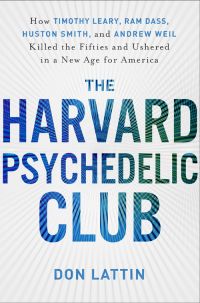
Like Jay Stevens' earlier book Storming Heaven, Don Lattin's recent 'Harvard Pychedelic Club' is a wryly tumultuous history, but whereas the former covers a wider scope ("LSD and the American dream"), the latter focuses sharply on the group that began in Cambridge. In contrast to Latttin's account, Gary Bravo's 'Birth of a Psychedelic Culture' brings us the ruminations of two of the surviving principals of the Harvard group, the scholarly Ralph Metzner and the psychologist formerly known as Richard Alpert, who transmogrified into the spiritual teacher Ram Dass. Their recorded conversation has the flavor of a lively reunion as the two recall an astonishing young adulthood, generously illustrated with snapshots and brief statements from colleagues.
[Thanks Jonathan!]
|

Recently @ DoseNation
|
|