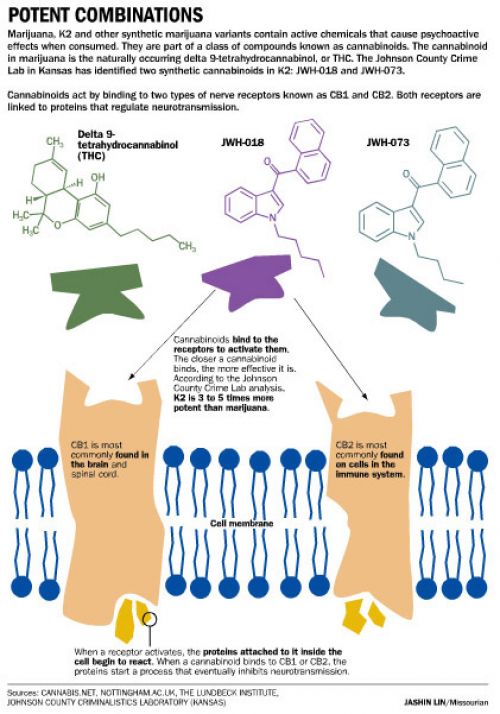
K2 is a combination of plant materials and two synthetic cannabinoids, according to Jeremiah Morris, a forensic scientist for the Johnson County Criminalistics Laboratory in Mission, Kan. The laboratory ran an analysis on K2 in October 2009 after noticing an increase in use in Johnson County.
"They found K2 to contain lab-produced drugs that act on the same part of the brain as marijuana," Morris said.
But the compounds in K2 are three to five times more potent than THC found in marijuana. Morris compared the effects of K2's compounds to a lock-and-key mechanism in which the lock is a receptor site of the brain and the key is the drug's compounds. The "keys" in K2 compounds are keys that fit the brain's "lock" better than those in marijuana.
[Thanks Thomas!]
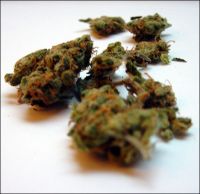 |
The first U.S. clinical trials in more than two decades on the medical benefits of marijuana confirm pot is effective in reducing muscle spasms associated with multiple sclerosis and pain caused by certain neurological injuries or illnesses, according to a report issued Wednesday.
Igor Grant, a psychiatrist who directs the Center for Medicinal Cannabis Research at the University of California, San Diego, said five studies funded by the state involved volunteers who were randomly given real marijuana or placebos to determine if the herb provided relief not seen from traditional medicines.
''There is good evidence now that cannabinoids may be either an adjunct or a first-line treatment,'' Grant said at a news conference where he presented the findings.
The California Legislature established the research center in 2000 to examine whether the therapeutic claims of medical marijuana advocates could withstand scientific scrutiny. In 1996, state voters became the first in the nation to pass a law approving pot use for medical purposes.
[Thanks 23 Wolves!]
Andy Letcher is a writer of non-fiction, specifically psychedelics, paganism, shamanism and evolution, a lecturer and a folk musician. He is the author of 'Shroom: A Cultural History of the Magic Mushroom', an evidence-based research project examining human relationships with psilocybin and Amanita mushrooms. He's also had an academic essay -- Mad thoughts on Mushrooms -- published in the Anthropology of Consciousness journal, wherein he uses a Foucauldian discourse analysis to examine psychedelic consciousness and mushrooms....
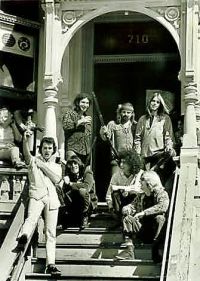 |
The Atlantic features an interesting piece on the coming opening of the Grateful Dead Archive, a treasure trove of arcana collected over the decades-long run of the band:
The Grateful Dead Archive, scheduled to open soon at the University of California at Santa Cruz, will be a mecca for academics of all stripes: from ethno musicologists to philosophers, sociologists to historians. But the biggest beneficiaries may prove to be business scholars and management theorists, who are discovering that the Dead were visionary geniuses in the way they created “customer value,” promoted social networking, and did strategic business planning.
While the piece spends the bulk of its word count dissecting the Dead's keen business instincts (a fine topic, to be sure), some other cultural tidbits are included related to the rise of Dead scholarship, such as:
In the late 1980s, Rebecca G. Adams, a sociologist at the University of North Carolina at Greensboro, who studies friendships formed across distances, noticed deep bonds between Deadheads. The bonds seemed to belie the idea, then popular among leading social thinkers, that communities based on common interest, whose members do not live near each other, lack emotional and moral depth—that Deadheads might belong to what sociologists call a “lifestyle enclave,” but couldn’t possibly form meaningful relationships. Adams brought a class on tour with the Dead—an opportunity, she thought, to teach classical theory while letting students study a cutting-edge contemporary community.
She became instantly famous, among a small group of scholars, and then, suddenly, among a much larger group of people. One day, without warning, Senator Robert Byrd, the histrionic and prodigiously opinionated West Virginian, gave a speech decrying what he considered an appalling decline in the standards for higher education, and cited Adams’s class as an example. Adams had unwittingly placed herself in the crosshairs of the culture wars and was beset by, among other things, an inquiry from the president of North Carolina’s state university system. Though she survived with help from her chancellor and her department head, and though the question fell squarely within her specialty, Adams was politely discouraged from pursuing her line of inquiry. “I was advised to concentrate on the more respectable areas of my research,” she told me.
[Via Techdirt]
From The Hook:
Super Bowl Sunday left Crozet resident Fred Carwile “frustrated and angry,” he says. And not because the Saints won.
That was the day he discovered that his sales listings for back-issues of High Times magazine, which he’s sold for years on eBay, had been yanked without warning.
Further infuriating Carwile: He claims that two different eBay customer service reps told him the marijuana-oriented mags were pulled at the request of the federal government.
“The federal government cannot ban books,” says Carwile, who notes that the cannabis culture magazine is sold at Barnes and Noble and countless convenience stores across the nation. “They’re pressuring a business to ban books.”
EBay insists it’s always been company policy to prohibit sales of items that “encourage, promote, facilitate, or instruct others to engage in illegal activities,” according to Anne Kott with APCO Worldwide, a PR firm.
Yet medical marijuana is legal in California, where eBay is based, and in 13 other states.
“Even though there might be states that allow it, eBay probably goes under federal law,” posits Kott, though the publicist-for-hire remains unable to explain the sudden enforcement of eBay policy against High Times, of which there were 600 completed transactions in just the past 30 days.
From Myeboga:
On Sunday 31st January at 6pm New York time, Howard Lotsof, discoverer of ibogaine’s anti-dependence properties and tireless campaigner for the rights of chemically dependent people, passed on quietly in Staten Island University Hospital. His wife & best friend, Norma, was by his side.
We all extend out sympathies to Norma and to those who will miss him dearly. He was an inspiration to many and embodied his own belief in service as a noble pursuit of man. May he rest in peace.
An excellent snippet from a larger article entitled, 'The Real Roots of the CIA's Rendition and Black Sites Program', from truthout.org.
The allegations of drugging by Mohamed and other prisoners are redolent of the use of hallucinogenic and other powerful mind-altering drugs by the US in its Artichoke, MK-ULTRA and other programs. A recent account, by Joby Warrick of The Washington Post, described some of these allegations of drugging of "detainees." The Post article subsequently led to an ongoing DoD Inspector General investigation into Possible Use of Mind Altering Substances by DoD Personnel during Interrogations of Detainees and/or Prisoners Captured during the War on Terror (D2007-DINT01-0092.005) "to determine if DoD personnel conducted, facilitated, or otherwise supported interrogations of detainees and /or prisoners using the threat or administration of mind altering drugs." According to his attorney's filings in the Jose Padilla case, Padilla, who was also originally implicated in the "dirty bomb" so-called plot with Binyam Mohamed, was forced to take LSD or other powerful drugs while held in solitary confinement in the Navy brig in South Carolina.
Another former Guantanamo prisoner, Mamdouh Habib, an Egyptian-born Australian Muslim released in 2005, has consistently told his tale of being subjected to electroshock, beatings and drugging while in US custody.
The CIA has been accused of involvement in continuing interrogation experimentation upon prisoners. The recent release of the previously censored summary of Mohamed's treatment in Pakistan notes that "The effects of the sleep deprivation were carefully observed." As Stephen Soldz notes in an article on the British court revelations, "Why were these effects being 'carefully observed' unless to determine their effectiveness in order to see whether they should be inflicted upon others? That is, the observations were designed to generate knowledge that could be generalized to other prisoners. The seeking of "generalizable knowledge" is the official definition of "research," raising the question of whether the CIA conducted illegal research upon Binyan Mohamed." The role of doctors, psychologists and other medical professionals in the CIA/DoD torture program has been condemned by a number of individuals in their respective fields, and by organizations such as Center for Constitutional Rights and Physicians for Human Rights.
Most recently, in an important article by Scott Horton at Harpers, the reexamination of the evidence in the supposed 2006 suicides of three prisoners at Guantanamo pointed to the possibility that the prisoners were killed in a previously unknown black site prison on the Guantanamo base - "Camp No" - run by the CIA or Joint Special Operations Command. This raises the question of why they were taken off site at all. One prisoner, 22-year-old Yasser Talal Al-Zahrani, had needle marks on both of his arms. The marks were notably not documented in the US military's autopsy report.
I've noticed from posting drug comedy videos on YouTube that some people really detest it when psychedelics are portrayed in a comic or satirical light. However, this particular video ties into a long-standing meme about staging the "Psychedelic Olympics" and is just too timely to overlook.
[Thanks, Carl!]
Yes, this is exactly what this news article is about.
"A physician may prescribe a drug and as far as seeing the drug, they may never have seen the tablet before and certainly never tried smelling it," said J. Russell May, a co-author of the clinical observation and a professor at the University of Georgia College of Pharmacy in Athens. Ga.
So, in addition to having no clue whatsoever about how a drug actually makes you feel, most doctors don't even know what they smell or taste like. I suppose none of this is surprising; it does seem like a minor but clear indicator of the problems with the detached, dualistic foundation of Western medicine. Compare with the origins of Chinese herbal medicine:
According to the legend the origins of traditional Chinese medicine is traced back to the to three legendary emperors/mythical rulers: Fu Xi, Shen Nong, and Huang Di... Shen Nong, the legendary emporar who lived 5000 years ago is hailed as the "Divine Cultivator"/"Divine Farmer" by the Chinese people because he is attributed as the founder of herbal medicine, and taught people how to farm. In order to determine the nature of different herbal medicines, Shen Nong sampled various kinds of plants, ingesting them himself for to test and analyse their individual effects. According to the ancient texts, Shen Nong tasted a hundred herbs including 70 toxic substances in a single day, in order to get rid of people's pain form illness.
Or, more recently, the research style of Alexander Shulgin:
After judicious self-experiments, Shulgin enlisted a small group of friends with whom he regularly tested his creations, starting in 1960. They developed a systematic way of ranking the effects of the various drugs, known as the Shulgin Rating Scale, with a vocabulary to describe the visual, auditory and physical sensations. He personally tested hundreds of drugs, mainly analogues of various phenethylamines (family containing MDMA and mescaline), and tryptamines (family containing DMT and psilocybin). There are a seemingly infinite number of slight chemical variations, all of which produce variations in effect—some pleasant and some unpleasant, depending on the person, substance, and situation—all of which are meticulously recorded in Shulgin's lab notebooks. Shulgin published many of these objective and subjective reports in his books and papers.
So phenomenologically-savvy science isn't dead, but it is certainly pining for the fjords...
When Matthew Bristow began chronicling the Colombian drugs trade, he was a freelance journalist fitting in trips to the jungle between paid assignments. Equipped with a Sony Z1, a small but broadcast-quality video camera often used by documentary makers, plus – just as importantly – a lot of patience, he aimed to make a film showing leaf-to-nose the cocaine chain that starts in the Andean jungle and ends in European or North American nostrils.
That film was never made; Bristow ran out of cash. What he did make -- in two years and for, he estimates, between $5,000 and $10,000 -- is a series of films on the Colombian end of the operation. The growing of the coca plant, the jungle labs where coca paste is refined to cocaine, and the river ports from where kilo packs hidden in speed boats are taken along the Pacific coast to Mexico or out into the Caribbean. Ever-present are the guerrillas, members of groups such as Farc (Revolutionary Armed Forces of Colombia), who exercise control over the coca lands and profit from the trade.
Bristow's films are going up this week on guardian.co.uk (some footage from the first, with the coca growers had previously shown on BBC Newsnight).
Bristow brushes aside suggestions that it was as dangerous as it may sound. "It's time consuming," he counters. "You can get there in two days but then you hang around waiting. Then they won't let you film the first time." But finding the guerrillas has become harder as Plan Colombia, the US-backed effort to rid Colombia of its cocaine trade, has pushed them further and further from the cities.
|

Recently @ DoseNation
|
|