 |
On Saturday, two beachgoers strolling near Dauphin Island’s West End discovered a pair of plastic-wrapped packages, each a little larger than a brick, containing cocaine.
Among the miscellanea that can wash up on beaches, drugs, usually bales of marijuana or blocks of cocaine, are rare, local police and federal officials say.
“It’s not common at all,” said Tom Wade, resident agent in charge of the Drug Enforcement Agency’s Mobile office. “I would call it an anomaly.”
In fact, New Orleans-based U.S. Coast Guard investigators can cull only one other example from recent memory: a bale of marijuana that washed up near New Orleans, said Lt. James McKnight, a Mobile-based spokesman for the Coast Guard.
Sometimes local police departments will handle such cases in their jurisdictions. Not often, though, said Gulf Shores Police Chief Arthur Bourne.
“I can’t recall the last time it’s happened,” he said.
It might have been a Saturday in June 1993. A child found two kilos of cocaine about a mile east of the city’s main public beach. The next afternoon, two teenagers from Kentucky stumbled upon a similar surprise west of Little Lagoon pass.
“That’s probably the last one,” Bourne agreed.
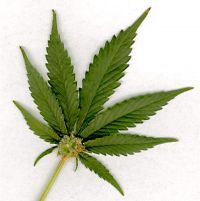 |
In 2007, there were over 150 published preclinical and clinical studies assessing the therapeutic potential of marijuana and several of its active compounds, known as cannabinoids. These numerous studies are in a book, now in its third edition, entitled Emerging Clinical Applications for Cannabis and Cannabinoids: A Review of the Scientific Literature. (NORML Foundation, 2008) One chapter in this book, which summarized the findings of more than 30 separate trials and literature reviews, was dedicated to the use of cannabinoids as potential anti-cancer agents, particularly in the treatment of gliomas...
In fact, the first experiment documenting pot’s potent anti-cancer effects took place in 1974 at the Medical College of Virginia at the behest federal bureaucrats. The results of that study, reported in an Aug. 18, 1974, Washington Post newspaper feature, were that marijuana’s primary psychoactive component, THC, “slowed the growth of lung cancers, breast cancers and a virus-induced leukemia in laboratory mice, and prolonged their lives by as much as 36 percent.”
...In the past 10 years scientists overseas have generously picked up where U.S. researchers so abruptly left off, reporting that cannabinoids can halt the spread of numerous cancer cells — including prostate cancer, breast cancer, lung cancer, pancreatic cancer, and brain cancer. (An excellent paper summarizing much of this research, “Cannabinoids for Cancer Treatment: Progress and Promise,” appears in the January 2008 edition of the journal Cancer Research.) A 2006 patient trial published in the British Journal of Cancer even reported that the intracranial administration of THC was associated with reduced tumor cell proliferation in humans with advanced glioblastoma.
Writing earlier this year in the scientific journal Expert Review of Neurotherapeutics, Italian researchers reiterated, “(C)annabinoids have displayed a great potency in reducing glioma tumor growth. (They) appear to be selective antitumoral agents as they kill glioma cells without affecting the viability of nontransformed counterparts.” Not one mainstream media outlet reported their findings. Perhaps now they’ll pay better attention.
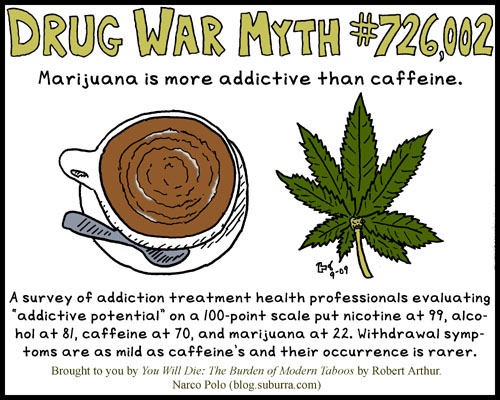
In covering the marijuana legalization debate the mainstream media is prone to comparing marijuana addictiveness to alcohol, cocaine, and heroin. A much more appropriate comparison would be to caffeine.
Two dead after Berlin doctor drugs 12 in therapy group
A German doctor was under arrest Sunday in connection with two deaths, after he administered mind-altering drugs to 12 patients in group therapy.
One patient phoned emergency services as all 12 collapsed with poisoning symptoms Saturday at the doctor's office in a Berlin suburb.
A 59-year-old man died soon after and a 28-year-old man in a coma died later in hospital.
Police said a third man was in critical condition after a coma all night, but the other nine had been discharged from hospital.
Prosecutors said the doctor, 50, admitted after his detention that he had given 'various substances and psycho-drugs' to the group, but interrogators saw no evidence that he had deliberately wanted to kill.
The drugs had been intended to 'extend their consciousness.' Police said they could not say yet what drugs were involved.
The nameplate outside the doctor's office, where he and his family also live, stated he offered 'psycholytic' therapy, possibly a reference to drugs such as LSD and mushroom extracts.
Unconfirmed accounts in Sunday newspapers said the psychology patients were offered a cocktail of heroin, amphetamines and Ecstasy. Distraught patients fought off the emergency doctors who were trying to help them, and had to be first calmed by police.
Group therapy is a common treatment for the mentally disturbed, both because it is less costly than individual treatment and because patients experience relief from talking to fellow sufferers.
Thanks to Toije for sending us this story!
Neurologist and author Oliver Sacks brings our attention to Charles Bonnett syndrome -- when visually impaired people experience lucid hallucinations. He describes the experiences of his patients in heartwarming detail and walks us through the biology of this under-reported phenomenon.
Maybe this is why they call it High Street. Police confirm the odd-looking plants they pulled last week from a flower basket in Millville's business district were indeed marijuana.
The plants were discovered by a passer-by. Police responded to the scene with a ladder and confiscated the 3-foot-tall plants, which were growing in a basket hanging from a lamp post.
The city's parks and recreation department, which tends to the baskets, says it has no idea how the pot plants got there.
A simple street-scenes reel with some trippy video effects.
Thanks Jason!
This article from ENCOD - the European Coaltion for Just and Effective Drug Policies - highlights a new and rising threat to youth around the world. It describes one horrific case of addiction to equasy:
The dangers of equasy were revealed to me as a result of a recent clinical referral of a woman in her early 30’s who had suffered permanent brain damage as a result of equasy-induced brain damage. She had undergone severe personality change that made her more irritable and impulsive, with anxiety and loss of the ability to experience pleasure. There was also a degree of hypofrontality and behavioural disinhibition that had lead to many bad decisions in relationships with poor choice of partners and an unwanted pregnancy. She is unable to work and is unlikely ever to do so again, so the social costs of her brain damage are also very high.
So what is equasy? And what can be done about it? Read the article for the details of this harrowing new social problem.
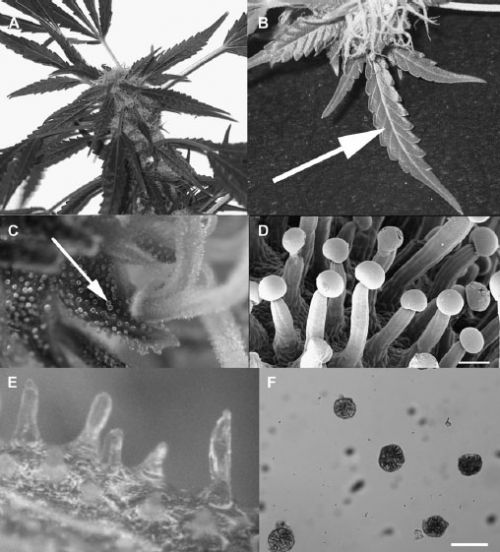
Bonus: Check out the eerie resemblance of the glands to psilocybe caps at nano scale!
RNA isolated from the glands of a D9-tetrahydrocannabinolic acid (THCA)-producing strain of Cannabis sativa was used to generate a cDNA library containing over 100 000 expressed sequence tags (ESTs). Sequencing of over 2000 clones from the library resulted in the identification of over 1000 unigenes. Candidate genes for almost every step in the biochemical pathways leading from primary metabolites to THCA were identified. Quantitative PCR analysis suggested that many of the pathway genes are preferentially expressed in the glands. Hexanoyl-CoA, one of the metabolites required for THCA synthesis, could be made via either de novo fatty acids synthesis or via the breakdown of existing lipids. qPCR analysis supported the de novo pathway. Many of the ESTs encode transcription factors and two putative MYB genes were identified that were preferentially expressed in glands. Given the similarity of the Cannabis MYB genes to those in other species with known functions, these Cannabis MYBs may play roles in regulating gland development and THCA synthesis. Three candidates for the polyketide synthase (PKS) gene responsible for the first committed step in the pathway to THCA were characterized in more detail. One of these was identical to a previously reported chalcone synthase (CHS) and was found to have CHS activity. All three could use malonyl-CoA and hexanoyl-CoA as substrates, including the CHS, but reaction conditions were not identified that allowed for the production of olivetolic acid (the proposed product of the PKS activity needed for THCA synthesis). One of the PKS candidates was highly and specifically expressed in glands (relative to whole leaves) and, on the basis of these expression data, it is proposed to be the most likely PKS responsible for olivetolic acid synthesis in Cannabis glands.
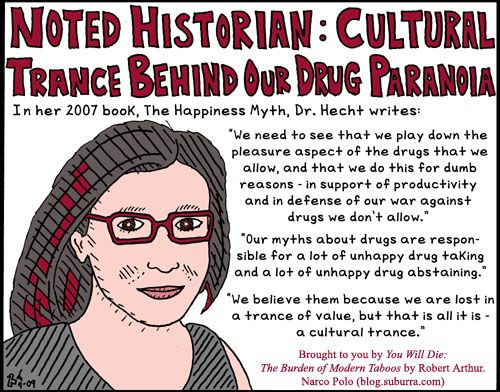
In her popular 2007 book, The Happiness Myth: Why What We Think Is Wrong, historian Jennifer Michael Hecht calls our current demonization of drugs a “cultural trance.” (p. 71) Just like past irrational attitudes the modern view of drugs may eventually reveal itself as, “bossy, shaming, controlling nonsense.” (p. 2)
|

Recently @ DoseNation
|
|